Increasing peer pressure for a clean and green Singapore
 Public reaction and support for Singapore to reclaim our status as one of the cleanest cities in the world has been very encouraging. I am grateful for all the many ideas and suggestions over the past few weeks.
One key element has been the need for increased and coordinated peer pressure, including empowering volunteers. NEA will conduct a special training course for senior members of environmental NGOs that will commence in January 2013. These volunteers will then be issued with authority cards which will enable them to identify and take enforcement action against recalcitrant persons who insist on littering. This will give them both moral and legal authority to set standards for our society.
Our world is changing profoundly at an unprecedented rate. We need a coalition of the government, private companies and NGOs to protect human welfare, the fragile ecosystem and biodiversity. We have to get the economics right too.
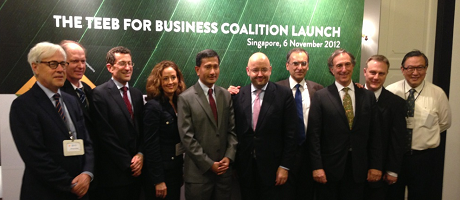 Transcript of my speech at the launch of the “The Economics of Ecosystems and Biodiversity for Business Coalition” at the Singapore Botanic Gardens on 6 November 2012
We live in a world, which perhaps unwittingly, has gone through a series of inflexion points at a rate which is unprecedented. Let me cite a few of these.
First, our world population has now exceeded seven billion. Clearly, that is unprecedented. Not only that, but for the first time ever in human history, more than half of all human beings live in a city, and not in the rural countryside. This is another world first.
Why governments, private sector and citizens all over the world need to collectively confront the looming crises of demographics, urbanisation, food-water-energy shortages, biodiversity, environmental integrity and human welfare
I attended the launch of the Economics of Ecosystems and Biodiversity for Business Coalition on 6 November 2012.
- Our world has rapidly passed through a series of inflexion points.
- First, our world population has exceeded 7 billion.
- Second, more than half of all human beings live in cities.
- Third, the age of cheap and plentiful natural resources – when we could literally scrape coal, iron ore, oil, gas easily from the surface of the planet – is ending.
- Fourth, we are running out of fresh water on a global scale.
- Fifth, the nexus between energy, water and food means we desperately need another agricultural revolution in the next decade or so.
- Sixth, we cannot afford to continue to simply dump pollutants, waste, toxins and carbon dioxide into the atmosphere and seas regardless of their impact on human health and safety and planetary ecology.
- Seventh, globalisation and information revolution has created enormous opportunities for billions of people from developing countries, but it has also created enormous competitive pressure on everyone. It has completely transformed the nature and value of employment and enterprise in half a century – probably a rate of change that is unparalleled in human history. It has also increased disparities between those able to exploit opportunities and those left behind.
Sustainable development
Exposing errant plantation companies causing transboundary smoke haze
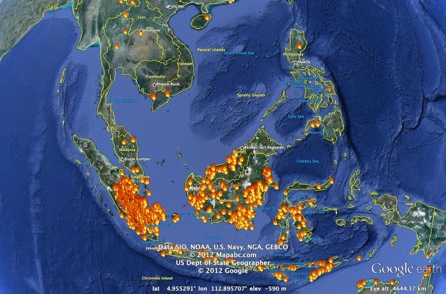
Just returned from Indonesia where I met ministers responsible for the environment from Brunei Darussalam, Indonesia, Malaysia and Thailand at the 14th Meeting of the Sub-Regional Ministerial Steering Committee (MSC) on Transboundary Haze Pollution.
We agreed that errant plantation companies and land owners should be held responsible and accountable for much of the haze pollution as they, rather than small shift cultivation farmers, were the major cause of the problem. We need more effective deterrent and enforcement measures against offenders.
Winning design of new Bukit Panjang Hawker Centre unveiled
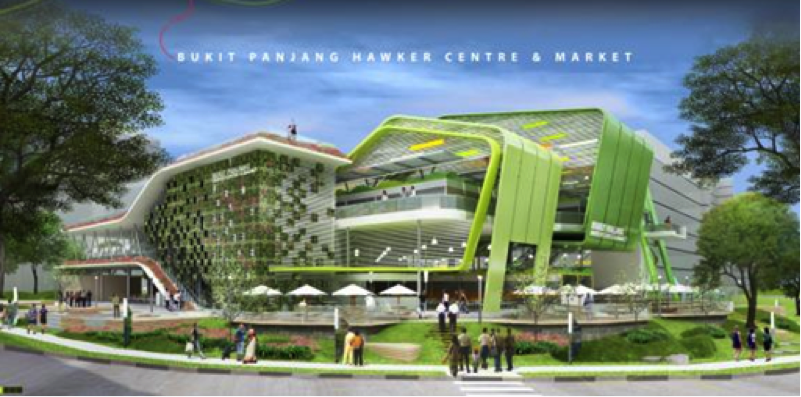
The BPHC design competition was launched on 11 June 2012 to commemorate the construction of the first hawker centre after 27 years. The NEA and the SIA co-organised the design competition for Bukit Panjang Hawker Centre and invited local architects to submit fresh ideas that could serve both the social and functional needs of the community. Special considerations were to be given to designs which proved attractive, practical and environmentally sustainable.
In memoriam : Jamal bin Dhari
A good friend Mr Jamal bin Dhari passed away early this morning.
He was a very good man, who used to drive me to many functions when I was at MND 10 years ago. When I apologised for making him work such long hours, his reply conveyed much political wisdom.
He told me that we should always try our best to accept all invitations because people wanted to know their leaders personally.